

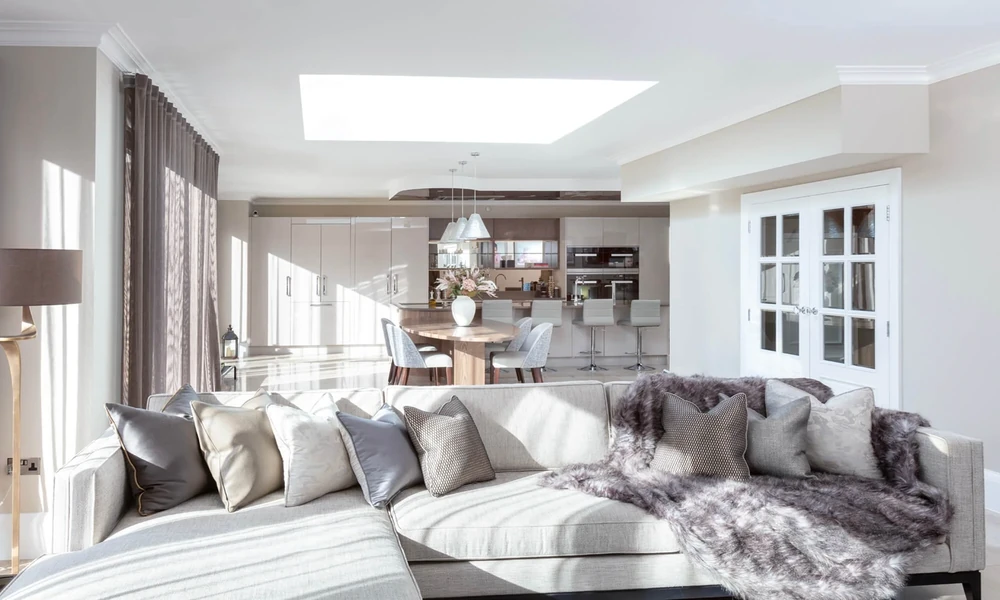
Interior design trends in Singapore homes have moved steadily toward cleaner lines over the past several years – fewer decorative mouldings, flatter cabinetry fronts, less visible hardware everywhere possible. Curtains eventually had to catch up to that shift, and S wave curtains, sometimes called S-fold, are the clearest example of window treatments adapting to a minimalist aesthetic rather than working against it. Their popularity isn’t really about a passing style trend so much as a genuine mechanical difference from how pleated curtains have traditionally hung. Once homeowners see the two styles side by side in a showroom, the difference in how the fabric moves and settles usually explains the preference better than any description can.
The Fold Itself Is the Design Feature
Traditional pinch-pleat curtains rely on stitched pleats at fixed intervals to create their shape, which produces a formal, structured look with visible gathering at the top. S wave curtains instead use a continuous ribbon of fabric tape sewn along the header, threaded through a specific track that pulls the fabric into a smooth, consistent S-shaped ripple across the entire width. There’s no hard pleat, no gathered bunching – just an even wave that repeats uniformly whether the curtain is fully open, fully closed, or somewhere in between.
Why That Suits Open-Concept Living Spaces
Open-concept condo layouts, where the living and dining areas share one long run of glass, benefit from a curtain style that reads as a single continuous element rather than a series of distinct pleated panels. The wave pattern in S-fold curtains keeps its shape consistently across a wide span, so a five or six metre stretch of window looks like one cohesive treatment instead of a repeated unit pattern, which matters more in larger, more open floor plans than it ever did in smaller, room-divided layouts.
A Cleaner Relationship With the Track
S wave curtains are almost always paired with a slim, often recessed track, since the wave header is designed to sit close against the rail rather than hang below it on hooks and rings the way traditional curtains do. The visual result is a track that all but disappears, with the fabric itself becoming the only visible element of the window treatment. Homeowners chasing a ceiling-to-floor look, especially with a cove or bulkhead concealing the track entirely, tend to gravitate to S-fold specifically because it was built for that kind of concealment.
How Fabric Choice Changes the Wave
Not every fabric holds an S-fold shape equally well. Lighter, crisper fabrics tend to hold the wave with a sharper, more defined curve, while heavier or looser weaves soften into a gentler ripple that reads more relaxed. This is worth testing against an actual fabric sample before committing, since the same wave-fold tape can produce noticeably different results depending on what it’s holding – a distinction that matters more with S-fold than with pleated styles, where the pleat shape is fixed by stitching regardless of fabric weight.
Motorisation Pairs Naturally With This Style
Because S wave curtains already use a slim, minimal track, they integrate cleanly with motorised systems without adding visible bulk. A homeowner who wants both the minimalist look and the convenience of automated opening and closing typically finds S-fold curtains one of the more straightforward styles to motorise, compared with heavier pleated curtains that can strain a motor across a long run. This combination shows up often in newer condo fit-outs where both the aesthetic and the automation were planned together from the start.
How the Wave Behaves in Motion, Not Just at Rest
Photographs of S-fold curtains almost always show them static, either fully open or fully closed, which misses one of the style’s real advantages: the way the wave moves when the curtain is drawn. Because there’s no stiff pleat holding a fixed shape, the fabric ripples smoothly as it travels along the track, without the slight jerk or bounce that pinch-pleat curtains can show at each pleat point. It’s a small detail, but it’s the kind of thing that makes a motorised S-fold curtain look noticeably more polished in operation than a motorised pleated one, since the movement itself becomes part of the visual effect rather than something to get through before the curtain settles.
What to Discuss Before Ordering
The wave spacing, fabric weight, and track type all need to be specified together rather than chosen independently, since a mismatch between a heavy fabric and a track designed for lighter material produces an uneven, sagging wave rather than the crisp look shown in samples. Anyone considering the style should look closely at how a supplier’s S-fold curtain fabrication is specified for their particular window, since getting the wave spacing right at the fabrication stage is far easier than adjusting it after the curtain is hung.
S wave curtains ended up popular in modern interiors for a fairly simple reason: they were the first curtain style built specifically to match the flatter, more continuous visual language that contemporary Singapore interiors had already moved toward. Everything else – the clean track, the compatibility with motorisation, the wide-span consistency – follows from that original design intent rather than being separate selling points bolted on afterward. For a homeowner weighing curtain styles for a new or renovated space, that alignment with the rest of the room’s design language is usually the deciding factor over any single technical feature.